

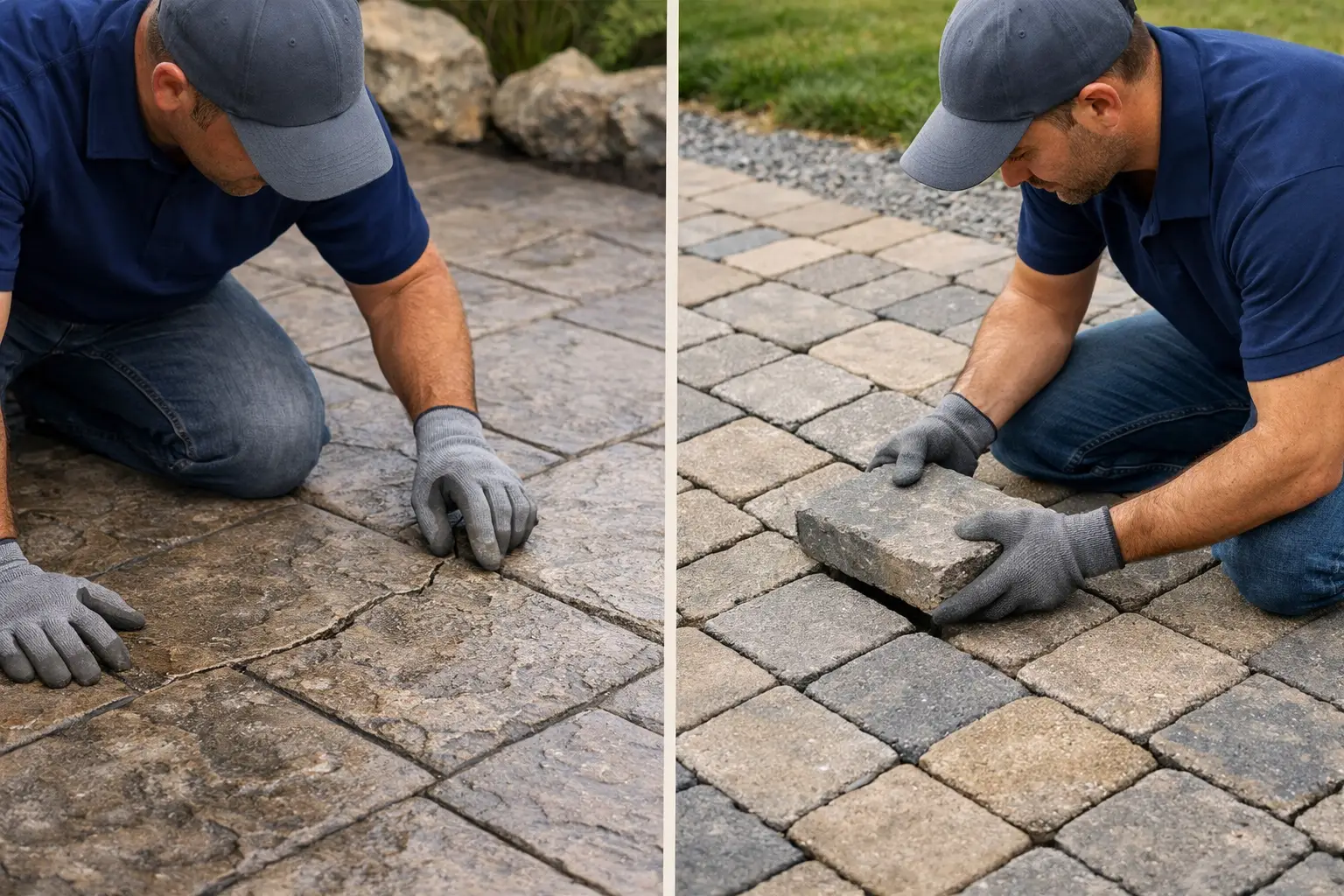
A patio can look finished the day it is installed and still become a source of frustration a few winters later. In the Portland area, long wet seasons, shifting soils, tree roots, and drainage challenges all affect how hardscape materials perform. When comparing stamped concrete vs pavers, the better choice is not simply the one with the lower initial price. It is the material and installation approach that fits your yard, intended use, and expectations for maintenance over time.
Both options can create attractive patios, walkways, pool surrounds, and outdoor living areas. The differences become clearer when you look below the surface at base preparation, water management, repairability, and long-term appearance.
Stamped Concrete vs Pavers: The Core Difference
Stamped concrete is a poured slab that is colored, textured, and patterned while the concrete is fresh. It can imitate natural stone, brick, slate, wood planks, or tile while maintaining the continuous appearance of a concrete surface. Because it is poured in place, stamped concrete works well for homeowners who want a broad, uniform patio with fewer visible joints.
Pavers are individual manufactured concrete or natural stone units installed over a prepared aggregate base. The units are laid in a chosen pattern, restrained at the edges, and finished with joint material. Paver systems have more joints by design, but those joints are also part of what makes the surface flexible and easier to repair.
Neither material is automatically better. A properly installed stamped concrete patio can be an excellent fit for a clean, cohesive design. A well-built paver patio can provide exceptional durability and flexibility. The result depends heavily on the condition of the site and the quality of the work beneath the finished surface.
Appearance and Design Options
Stamped concrete offers a wide range of pattern and color combinations without the cost of setting individual stone pieces. It can create a custom-looking surface over a large area and pairs well with contemporary homes, covered patios, and outdoor kitchens. Borders, contrasting release colors, saw-cut control joints, and integral color can add definition to the design.
Its main visual limitation is repetition. Even high-quality stamping can look less natural than real stone or a thoughtfully selected paver blend, particularly in a smaller space where the pattern is easy to study. Color can also fade gradually with sun exposure and weather if the surface is not maintained and resealed as needed.
Pavers offer more texture, color variation, and pattern choices at the unit level. They can create a formal running bond walkway, a traditional cobble-style drive, or a large-format patio with a more modern feel. Pavers are especially effective when a landscape design includes retaining walls, steps, fire features, or masonry accents that need to work together visually.
For homeowners who want a natural, layered outdoor space rather than one continuous slab, pavers usually provide more design flexibility. For those who prefer a smooth, unified surface with a decorative finish, stamped concrete may be the stronger visual fit.
Portland Weather, Drainage, and Ground Movement
Water management should be part of the material decision, not an afterthought. Portland-area properties commonly deal with saturated soil, roof runoff, slopes, and areas where water collects near the house. Any patio or walkway needs proper pitch to direct surface water away from the foundation and toward an appropriate drainage solution.
Stamped concrete is impermeable. Rainwater runs across the surface, so its slope and drainage details must be correct from day one. If water is directed toward a structure, pools at an edge, or erodes the surrounding grade, the problem can affect both the patio and the property. Control joints help manage where concrete cracks, but they do not prevent all cracking caused by settlement, roots, or soil movement.
Pavers also require drainage planning, but their jointed system can accommodate minor movement more gracefully than a solid slab. In some applications, permeable pavers can help water filter through the surface into a properly designed base. That is not the right answer for every yard, and it must be engineered around the site’s soil conditions and drainage needs. Still, it can be valuable where managing stormwater is a priority.
The key is excavation and base preparation. A beautiful surface installed over insufficient compacted base material can settle, shift, or hold water regardless of whether it is concrete or pavers. On challenging sites, drainage correction, grading, and structural preparation should be completed before the finish material is installed.
Cost: Initial Price and Long-Term Value
Stamped concrete often has a lower upfront cost than a premium paver installation, especially for a large, uncomplicated patio. Material placement is faster than individually laying pavers, although detailed patterns, borders, multiple colors, curved forms, and difficult access can increase the price.
Pavers typically cost more initially because the installation is labor-intensive and requires careful excavation, base construction, leveling, cutting, edge restraint, and joint finishing. Natural stone pavers and intricate layouts add further cost. However, higher initial cost can make sense when the project requires complex transitions, future access to utilities, or a surface likely to need spot repairs.
Homeowners should be cautious about comparing quotes only by square footage. A lower price may exclude demolition, haul-off, drainage work, base depth, compacted aggregate, reinforcement, steps, edging, or site restoration. A transparent proposal should explain what is being built below the surface as clearly as what will be visible when the work is complete.
Maintenance and Repair Expectations
Stamped concrete needs periodic cleaning and resealing to protect its color and finish. The frequency depends on exposure, traffic, and product selection, but most surfaces benefit from being evaluated every few years. De-icing products, heavy furniture dragged across the surface, and neglected drainage can shorten the life of the finish.
The larger concern is cracking. Concrete naturally shrinks and moves as it cures, which is why control joints are planned into the slab. Those joints help create orderly lines, but cracks can still develop outside them. Small cracks may be repaired or blended, though repairs rarely disappear completely. If a large section heaves, settles, or cracks, replacement can be more involved.
Pavers need occasional cleaning, joint sand maintenance, and attention to weeds or moss in damp, shaded locations. If a section settles or becomes stained, individual units can usually be lifted, the base corrected, and the same or matching pavers reinstalled. This repairability is one of the most practical advantages of a paver system.
For driveways, pavers can handle vehicle loads when they are designed with the right paver thickness and base depth. Stamped concrete can also be used for driveways, but its slab thickness, reinforcement, joints, and subgrade preparation need to match the load. In either case, a driveway should not be built like a patio.
Which Material Fits Your Project?
Stamped concrete is often a good choice when you want a continuous decorative surface, have a relatively stable site, and prefer a lower initial investment. It is particularly effective for covered patios, simple backyard entertaining areas, and designs where a patterned slab complements the home.
Pavers are often the better choice when drainage, minor ground movement, future repairs, or detailed design are major considerations. They are also a strong option for patios that connect to retaining walls, pathways, steps, and landscape features, where transitions and changes in elevation need careful attention.
A site visit is the best way to make the decision with confidence. At Four Seasons Landscape & Construction, the planning process considers access, existing grades, runoff, soil conditions, intended use, and the other features that may be part of the yard transformation. That helps avoid choosing a surface based on a showroom sample alone.
The right patio should feel solid underfoot, drain properly in a January rain, and still support the way you use your yard years from now. Start with the condition of the property, then choose the material that gives your outdoor space the best foundation for lasting use.