

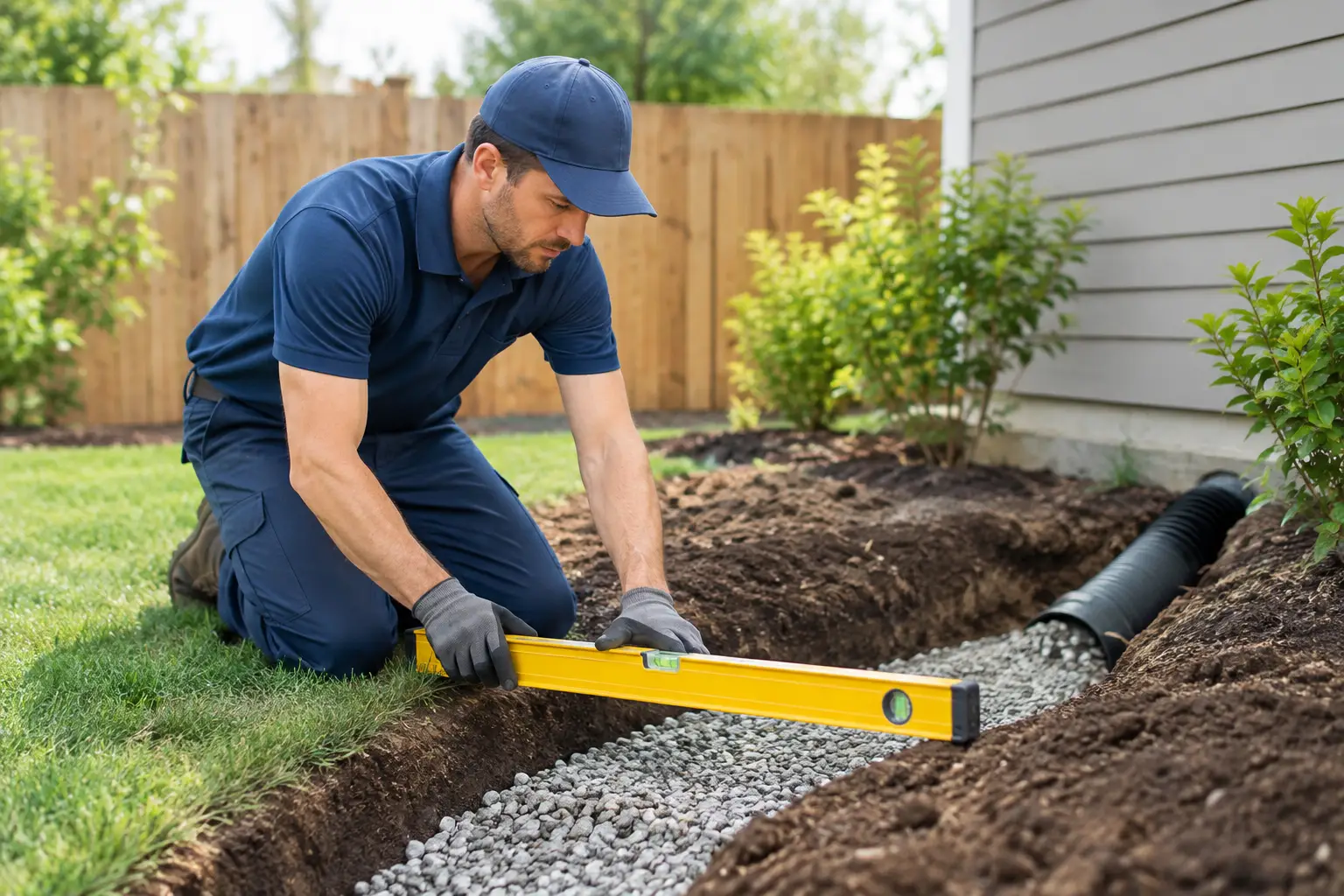
A backyard can look level, green, and well maintained while still sending water toward the house. In the Portland area, where long wet seasons expose every low spot and drainage shortcut, knowing how to grade backyard drainage is about more than keeping shoes out of the mud. Proper grading protects the foundation, preserves patios and retaining walls, and makes the yard usable year-round.
The goal is simple: collect water where it naturally lands, move it safely away from structures, and release it where it can drain without creating a new problem for a neighbor or a lower area of the property. The right solution depends on the lot, soil, existing hardscape, roof runoff, and the elevation of adjoining properties.
Start With the Water You Already Have
Before bringing in soil or renting equipment, observe the yard during a steady rain. Look for ponding water, muddy areas, overflowing gutters, downspouts that empty beside the foundation, and runoff flowing across patios or walkways. A hose can help reveal smaller drainage issues on a dry day, but it will not fully replicate the volume of a Portland downpour.
Pay close attention to where water starts and where it stops. A low area in the lawn may be the visible symptom, but the source could be a high point near the house, a disconnected downspout, compacted soil, or a patio sloped in the wrong direction. Water that appears at the base of a retaining wall may be trapped behind it because the wall was built without enough drainage rock, perforated pipe, or outlet protection.
Also identify what cannot be changed easily: foundation elevations, property lines, mature trees, utility routes, existing fences, and hardscape. Call for utility locates before any excavation. If water is entering a crawl space, affecting a retaining wall, or washing soil out from below concrete, the project deserves a professional site assessment rather than a quick topsoil fix.
Establish the Correct Grade Away From the House
The area immediately around the home is the first priority. Finished soil should slope away from the foundation so surface water does not collect at the wall. A commonly used target is a drop of about 6 inches over the first 10 feet away from the house. That works out to roughly a 5 percent slope, though site conditions, siding clearances, doors, decks, and established landscaping can affect what is practical.
Do not solve a drainage issue by piling soil against siding, trim, weep holes, or vents. The finished grade must remain below the building materials and preserve the clearances required for the home. On some properties, there simply is not enough room to achieve the preferred slope before reaching a fence, walkway, or neighboring lot. In that case, a swale, area drain, tightline, or retaining solution may be needed to carry water away.
Use a string line, line level, laser level, or transit to verify the grade. Visual judgment is not precise enough for drainage work, especially when a yard has subtle changes in elevation. Measure from the intended finished grade near the house to the intended outlet area, not from the current uneven lawn surface.
Avoid the “Bowl” Around the Foundation
Adding soil without shaping the surrounding yard can accidentally create a shallow bowl. Water then runs down the new slope, hits a flat edge near a patio, fence, or planting bed, and stays there. The corrected grade needs a continuous route for water to follow.
That route may be a broad, shallow swale through the lawn. A swale is not a ditch with steep sides. It is a gradual depression that guides runoff across the property while still allowing the lawn to be mowed and used. When designed well, it looks like part of the landscape rather than an obvious drainage feature.
Choose an Outlet Before Moving Dirt
Every grading plan needs a legal, practical destination for water. This is where many do-it-yourself drainage projects go wrong. Water cannot simply be redirected to the property line, under a fence, or toward a neighbor’s yard. Doing so may cause erosion, standing water, fence damage, or disputes, and it can violate local requirements.
Depending on the site, a suitable outlet may be a lower landscaped area, an approved stormwater connection, a dry well designed for the soil conditions, or a drainage system that carries roof runoff to an appropriate discharge point. Clay-heavy or compacted soils, which are common in parts of the Portland metro area, may not absorb water quickly enough for a simple gravel pit to work. High groundwater and seasonal saturation can further limit where water can go.
A drainage outlet should also be protected from erosion. Fast-moving water leaving a pipe can carve channels through mulch or soil. River rock, splash protection, a catch basin, or a properly designed dispersal area can slow the flow and keep the outlet stable.
How to Grade Backyard Drainage Around Patios and Walkways
Hardscape changes the grading plan because concrete, pavers, and stone do not absorb water. A patio should generally slope away from the house, usually at least 1/8 inch per foot and often closer to 1/4 inch per foot where the layout and finish allow. The exact slope depends on the material, the size of the paved area, accessibility needs, and where the water will go after it leaves the surface.
A patio that drains toward the foundation can sometimes be corrected with a channel drain, but a drain should not be used to excuse a fundamentally incorrect grade. Channel drains need proper pipe connections, cleanouts, and maintenance access. Leaves, moss, gravel, and sediment can block them if they are treated as a set-it-and-forget-it feature.
For paver patios, the base is just as important as the surface slope. Water that reaches an improperly built base can soften the bedding layer, cause settlement, and create low spots that hold water. A well-built patio includes proper excavation, compacted aggregate base, edge restraint, and a finished elevation that works with the surrounding landscape.
Walkways need the same attention. Water should not sheet across a path and create a slick crossing point. In some cases, the best solution is to reshape adjacent planting beds so runoff moves beside the walkway instead of over it.
Combine Surface Grading With Drainage Systems When Needed
Grading is often the first and most effective tool, but it cannot solve every site condition by itself. A yard with a high water table, a narrow side yard, a below-grade patio, or heavy roof runoff may need a combination of grading and subsurface drainage.
A French drain can help collect water moving through saturated soil, but it must be installed at the right depth and with a clear outlet. It is not a cure for surface water that has no place to go. Likewise, solid pipe is usually better for carrying downspout water quickly to a discharge point, while perforated pipe is used where the goal is to collect groundwater along its length.
Retaining walls require a coordinated approach. If a wall holds back soil, the drainage behind it must be addressed during construction with clean drain rock, filter fabric where appropriate, perforated pipe, and outlet locations. Regrading above or below an existing wall without considering its drainage can increase pressure on the structure.
Build the Grade in Layers and Check It Often
Once the plan is set, remove organic debris, loose mulch, and unsuitable material from the work area. Place clean fill soil in manageable lifts rather than dumping a deep layer all at once. Compact each layer enough to limit future settlement, then recheck elevations before adding more material. Over-compaction in a planting area can create its own problem, so the soil should be firm and shaped correctly without being packed like a driveway base.
Topsoil is for planting and finish work, not for building significant elevation. If the yard needs substantial regrading, use suitable structural fill below the topsoil layer. Finish the surface smoothly so water has a consistent direction of travel, then establish sod, seed, mulch, or planting as soon as practical to limit erosion.
After the first major rain, walk the property again. Small adjustments are normal. Watch the foundation perimeter, the edges of patios, low lawn areas, drain inlets, and discharge points. Drainage work is successful when water leaves the surface without undermining the improvements you made to enjoy the yard.
For larger Portland-area drainage projects, the best results come from planning the grade, hardscape, retaining work, and drainage piping as one system. Four Seasons Landscape & Construction can assess the conditions on site and build a solution that fits the property instead of forcing a one-size-fits-all fix. A properly graded yard should feel like a natural part of the landscape – even when the rain has been falling for days.