

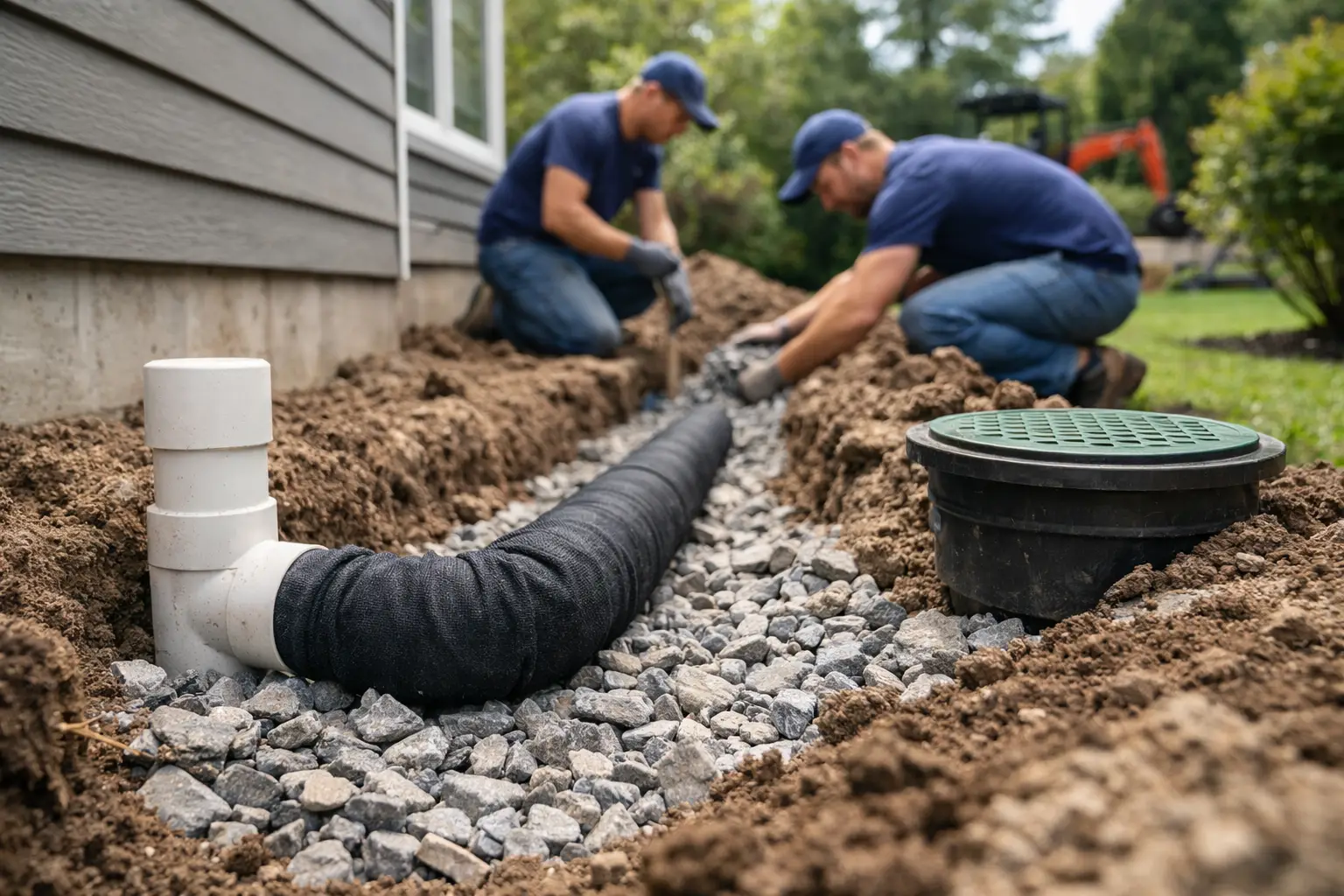
A Portland-area yard can look perfectly level and still hold enough water to soften a lawn, flood a planting bed, or push moisture toward a foundation. Understanding how french drains work helps homeowners recognize when subsurface drainage is the right solution – and when the real issue calls for grading, downspout work, or a more complete drainage plan.
A French drain is not a cure-all for every wet yard. When it is designed around the property’s soil, slope, runoff sources, and safe outlet, however, it can move unwanted water away from the areas where it causes the most trouble.
How French Drains Work
A French drain collects water below the surface and directs it to a designated discharge point. It is typically built as a narrow trench lined with filter fabric, filled with clean drain rock, and fitted with perforated drain pipe. Water enters through the soil and rock, flows into the pipe through its openings, and travels downhill to an approved outlet.
The system works because water follows the easiest available path. Saturated soil around a low spot, retaining wall, foundation area, or lawn moves into the more open spaces between the drain rock. From there, the perforated pipe carries that water away rather than allowing it to remain trapped in the soil.
Gravity does the work. The pipe needs continuous fall from its starting point to its outlet. A drain that is flat, back-pitched, or blocked at the discharge end may hold water instead of moving it. That is why successful drainage is less about simply burying a perforated pipe and more about planning the entire route before excavation begins.
The Main Parts of a French Drain
A properly installed French drain relies on several components working together. The trench is sized for the amount of water expected and the available depth. Filter fabric separates the drain rock from surrounding soil, helping prevent fine particles from migrating into the rock and pipe.
Washed drain rock creates open voids for water to move through quickly. The perforated pipe, usually rigid or flexible drainage pipe selected for the application, receives groundwater and conveys it downslope. The pipe is then covered with additional rock and wrapped or overlapped with fabric before the trench is restored with soil, lawn, mulch, or decorative gravel.
The outlet is equally important. Depending on the property, water may discharge to a suitable lower area, a dry well designed for the site, a storm drainage connection where permitted, or another approved drainage feature. The outlet must be protected from erosion and kept clear. It also needs to comply with local requirements, since redirecting water onto a neighbor’s property is not an acceptable solution.
Where a French Drain Makes Sense
French drains are most effective when the problem is groundwater or water moving through the soil. They are commonly used along the uphill side of a yard, beside a retaining wall, near chronically wet lawn areas, and around landscape features affected by saturated ground.
For example, a backyard below a neighboring slope may receive steady subsurface runoff during Portland’s wet months. A French drain installed along the upper edge of the yard can intercept that water before it reaches a patio, turf area, or foundation planting bed. In another situation, a drain behind a retaining wall can relieve water pressure that would otherwise build up in the backfill.
They can also be useful around foundation areas, but this work requires careful evaluation. Drainage near a house must account for footing depth, existing foundation drains, utilities, access, and discharge options. Digging close to a foundation without a plan can create more risk than benefit.
A French drain is usually not the first choice for water that is clearly coming from roof downspouts. Downspouts need solid pipe that carries roof runoff directly to an appropriate outlet. Connecting roof water to a perforated French drain can overload the system and spread water into the surrounding soil. In many yards, the best answer is a coordinated system: solid pipe for downspouts, surface grading for runoff, and a French drain where groundwater needs to be intercepted.
Slope, Soil, and Outlet Determine Performance
The visible finish of a drainage project matters, but the details below grade determine whether it performs over time. Before a trench is dug, the contractor should identify where water originates, how it currently travels, and where it can go safely.
Portland-area properties vary widely. Heavy clay soils are common in many neighborhoods and tend to drain slowly. A French drain can help create a preferred route for water in clay soil, but it cannot make dense soil behave like sandy soil overnight. If a yard has broad low areas with no natural fall, the project may need regrading, catch basins, a dry well, or a pump-assisted solution in addition to a French drain.
Slope is measured rather than guessed. Even a modest, consistent pitch can move water effectively, while a trench that rises and falls creates low spots where sediment can collect. The outlet must remain lower than the drain and be accessible enough for future inspection.
Depth is also site-specific. A shallow drain may be appropriate for a soggy lawn or planting bed. A deeper interceptor drain may be needed to collect water moving below the surface on a slope. Going deeper is not automatically better. Utility locations, tree roots, hardscape edges, and foundation conditions all influence the safe depth and route.
Installation Requires More Than a Gravel-Filled Trench
Many failed French drains have one thing in common: they look like a drainage system but lack the construction details that keep water moving. A trench filled with random rock and pipe can clog, collapse, or drain poorly if it was not installed at the proper grade.
A professional installation begins with layout and utility locating. The drainage route is marked, elevations are checked, and the outlet is confirmed before excavation. The trench is then excavated to consistent depth and slope. Filter fabric is placed along the bottom and sides, followed by washed rock and pipe set at the planned grade.
The pipe orientation depends on the system design and pipe type, but the goal remains the same: allow water in while maintaining a clear route out. More drain rock is placed around and above the pipe, and the fabric is folded over the rock to reduce soil intrusion. The surface is restored to match the surrounding landscape or to serve a planned purpose, such as a gravel border along a foundation.
If the drain crosses beneath a walkway, patio, or driveway, the installation needs additional planning. Future access, compaction, pipe protection, and the relationship between the drainage system and the hardscape base all matter. This is one reason homeowners often benefit from handling drainage before new pavers, concrete, retaining walls, or landscaping are installed.
Common Problems a French Drain Will Not Fix Alone
A French drain may reduce saturated soil, but it cannot correct a roof drainage problem if gutters overflow or downspouts discharge beside the house. It also cannot overcome a patio or driveway that is pitched toward the foundation. Surface water needs a surface solution, such as regrading, a channel drain, a catch basin, or drainage improvements built into the hardscape.
Tree roots can be another consideration. Large roots may limit where a trench can go, and cutting significant roots can affect tree health or stability. Mature trees, existing irrigation lines, buried electrical service, and gas lines should all be considered before selecting a route.
Maintenance is generally limited but still necessary. Drain outlets should be checked periodically, particularly after heavy storms. Keep outlet areas clear of leaves, mulch, and soil. If a system includes cleanouts, they provide a practical way to inspect or flush the line if reduced flow becomes a concern.
Plan Drainage as Part of the Whole Yard
The best drainage work often disappears when the project is complete. The lawn is usable, the patio stays drier, planting areas are healthier, and water is directed away from structures without creating a new problem elsewhere.
For homeowners planning a retaining wall, paver patio, concrete work, or complete landscape renovation, drainage should be addressed early rather than added after the finished surface begins showing water issues. Four Seasons Landscape & Construction can evaluate drainage alongside the larger site plan, helping ensure the work below ground supports the outdoor space you want to enjoy above it.