

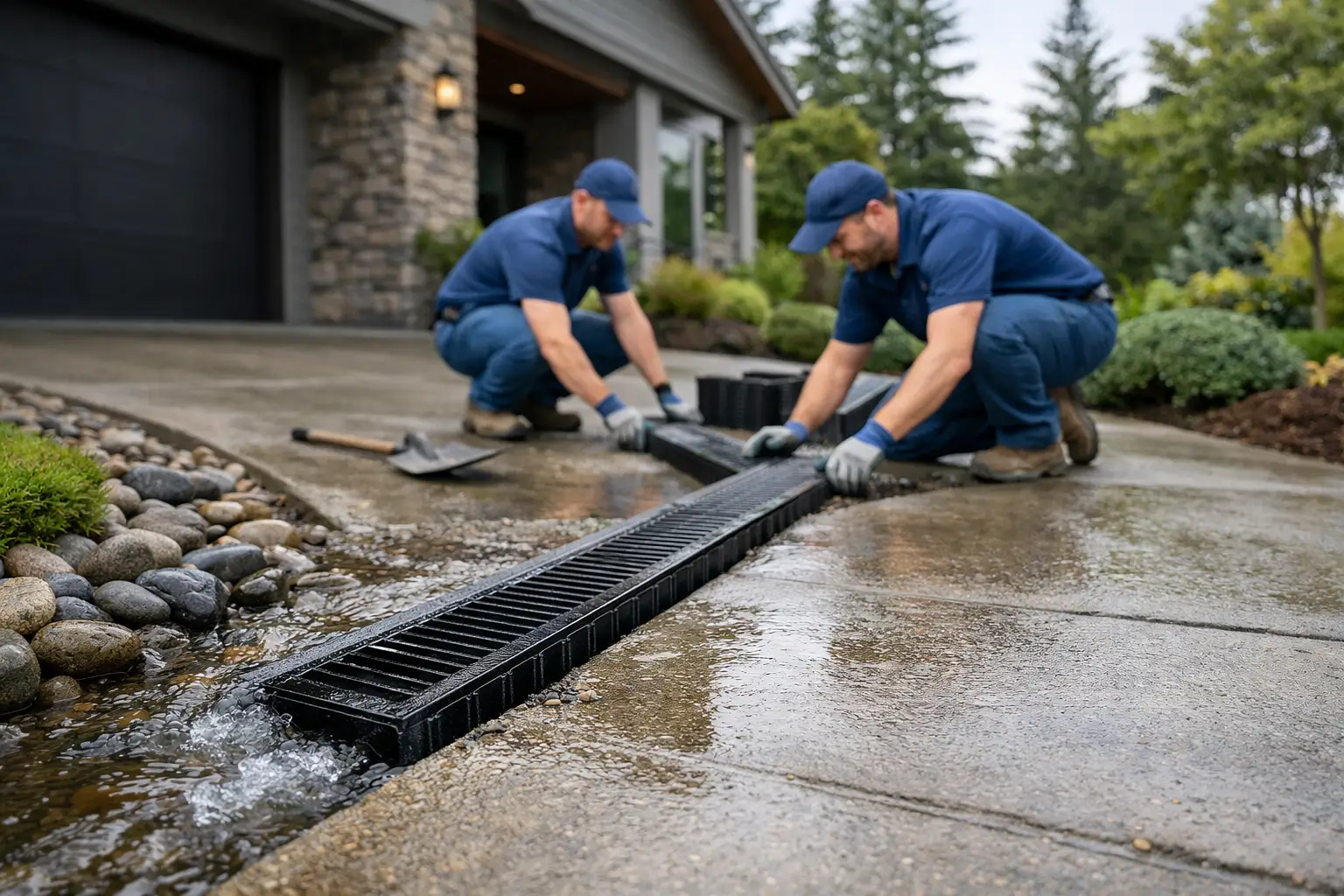
A driveway should direct rainwater away from your garage, foundation, walkways, and landscape beds from the day it is installed. In the Portland metro area, that is not a minor detail. Months of steady rain can expose low spots, failed edges, and poorly planned drainage quickly. This driveway drainage design guide explains the practical decisions that help protect your property before new concrete, pavers, asphalt, or gravel go in.
The best solution is rarely just adding a drain after puddles appear. Effective driveway drainage begins with an honest assessment of the property’s slope, soil, existing runoff paths, and the areas that must stay dry. A driveway is part of a larger site drainage system, and it needs to work with the yard rather than push water toward the home or a neighboring property.
Start With Where Water Is Going Now
Before selecting a trench drain or changing the driveway surface, look at the existing water movement during and after a strong rain. Water may enter from an uphill lawn, roof downspout, street, side yard, or neighboring grade. It may also be trapped by a garage threshold, retaining wall, fence line, or raised landscape border.
Standing water tells only part of the story. Watch for washed-out gravel, dark staining on concrete, moss at driveway edges, soil erosion, wet crawlspace conditions, and water marks inside the garage. These signs can point to a larger grading issue rather than a problem limited to the driveway itself.
For Portland-area homes, clay-heavy soils are common and can drain slowly. A driveway built over compacted soil with no outlet for runoff may hold water even when the visible surface slope appears reasonable. Site conditions determine whether the project needs simple regrading, a collection drain, a catch basin, subsurface pipe, or a combination of these measures.
Driveway Drainage Design Guide: Build the Slope First
Surface grading is the first line of defense. Water should flow across the driveway and toward a planned collection or discharge area, not sit in the wheel paths or run straight at the garage. The exact slope depends on the driveway layout, material, access needs, and surrounding grades, but the goal is consistent: create enough fall for drainage while keeping the surface comfortable and safe to use.
A driveway that slopes toward the street may be straightforward if the street-side edge can handle runoff properly. A driveway that descends toward the house needs more attention. In that situation, the driveway may need a channel drain across the approach to the garage, with piping that carries collected water to an approved discharge location.
Cross slope matters as much as lengthwise slope. A slightly crowned driveway can shed water to both sides. In other conditions, a single-plane slope directs water to one edge, where a swale, drain, or landscape collection area can receive it. The right choice depends on available space and where water can safely go.
Avoid relying on a narrow strip of gravel or a planting bed to solve substantial runoff. Those areas can become saturated, erode, and allow water to migrate back under the pavement. Drainage has to be designed below the finished surface, not treated as a cosmetic edge detail.
Choose Drainage Components That Match the Problem
Not every driveway needs every type of drain. Adding unnecessary components can increase cost and maintenance without addressing the actual source of water. A professional site review helps identify the most appropriate system.
Channel Drains at Garage Entrances
A channel drain, often called a trench drain, is installed across the driveway near a garage door or other low threshold. It collects sheet flow before water can enter the garage. This is often a strong option for driveways that slope down toward the home.
The drain must be set at the correct elevation, supported on a stable base, and connected to a properly sized outlet pipe. The grate should be durable enough for vehicle traffic and accessible for cleaning. A channel drain with no reliable outlet simply becomes a narrow trough that fills with sediment.
Catch Basins for Concentrated Runoff
Catch basins collect water at low points or where several drainage paths meet. They can be useful near driveway corners, transitions, or areas where runoff from a hardscape and landscape surface combines. A basin also provides a place for sediment to settle before water enters the drain line.
Placement is critical. Installing a basin slightly uphill from the true low point will not stop pooling. The surrounding surface must direct water cleanly into it, and the grate should remain clear of leaves, bark dust, and debris.
Perforated Pipe and Drain Rock
Perforated drain pipe surrounded by clean drain rock is used to collect water moving through the soil. It can help relieve wet driveway edges, saturated planting areas, and water pressure behind retaining walls. It is not a replacement for surface drainage where large volumes of water are flowing across pavement.
For long-term performance, the drain rock and pipe need separation from native soil with appropriate filter fabric. Without that separation, fine soil can migrate into the rock and reduce the system’s ability to move water.
Swales and Landscape Drainage Areas
Where property conditions allow, a shallow, graded swale can guide water through the landscape rather than concentrating it at one hard edge. This can be a practical choice for larger yards and driveways with room to direct runoff away from structures.
The trade-off is that a swale requires enough space and proper grading. It must not create a muddy strip of lawn or direct water toward a neighbor. In tighter residential lots, buried drainage and carefully planned surface collection are often more practical.
Plan the Base Below the Driveway Surface
A durable driveway needs more than a finish material that looks good on day one. The excavation depth, compacted aggregate base, edge restraint, and drainage layer all affect how well the surface handles water and vehicle loads.
When water remains beneath concrete, pavers, or asphalt, it can soften the subgrade and contribute to settlement, cracking, movement, and edge failure. Portland’s wet season makes proper base preparation especially valuable. During construction, soft or unsuitable material may need to be removed and replaced rather than buried beneath a new driveway.
Paver driveways require particular attention to edge restraint and base compaction. Water moving under poorly restrained pavers can shift the system over time. Concrete driveways also need well-prepared subgrade and control joints, but the drainage plan should never depend on cracks or joints to carry runoff away.
If the driveway adjoins a retaining wall, steps, patio, or walkway, the whole hardscape layout should be evaluated together. Building each feature separately can leave awkward low points between surfaces. One coordinated plan produces cleaner transitions and fewer drainage surprises.
Respect Property Lines and Discharge Requirements
Water should not be redirected onto a neighboring property, across a sidewalk, or into a location where it creates icing, erosion, or nuisance runoff. Depending on the site and scope of work, local requirements may affect where driveway drainage can discharge and whether permits are needed.
This is one reason a low bid can become expensive later. A contractor may offer a new driveway without considering roof runoff, existing drain connections, street conditions, or the correct outlet for a new channel drain. The finished surface may look clean, but the homeowner is left with the same water problem in a different form.
A clear proposal should explain the planned grade, drainage components, discharge direction, excavation, base preparation, and surface material. If unknown conditions are possible, such as buried debris, unstable soil, or damaged existing pipes, those should be discussed before work begins.
Know When a Driveway Replacement Is the Right Time
Drainage improvements are usually most efficient when paired with driveway replacement, major hardscape work, retaining wall construction, or yard regrading. The equipment is already on site, the surface is open, and the drainage system can be installed at the correct depths and elevations.
If the driveway is structurally sound and the concern is limited to one localized low spot, targeted drainage may be enough. But if the surface is cracked, settling, sloping toward the garage, or failing at the edges, patching around the problem may only delay a more complete repair.
At Four Seasons Landscape & Construction, driveway drainage is evaluated as part of the entire exterior project. That means considering the driveway, garage approach, landscape grade, retaining walls, walkways, and runoff path together so the final work is built to perform through Oregon’s wet weather.
A well-designed driveway should make rain uneventful. When the next heavy storm arrives, water should move where it was planned to go, while your garage, foundation, and finished outdoor spaces stay protected.