

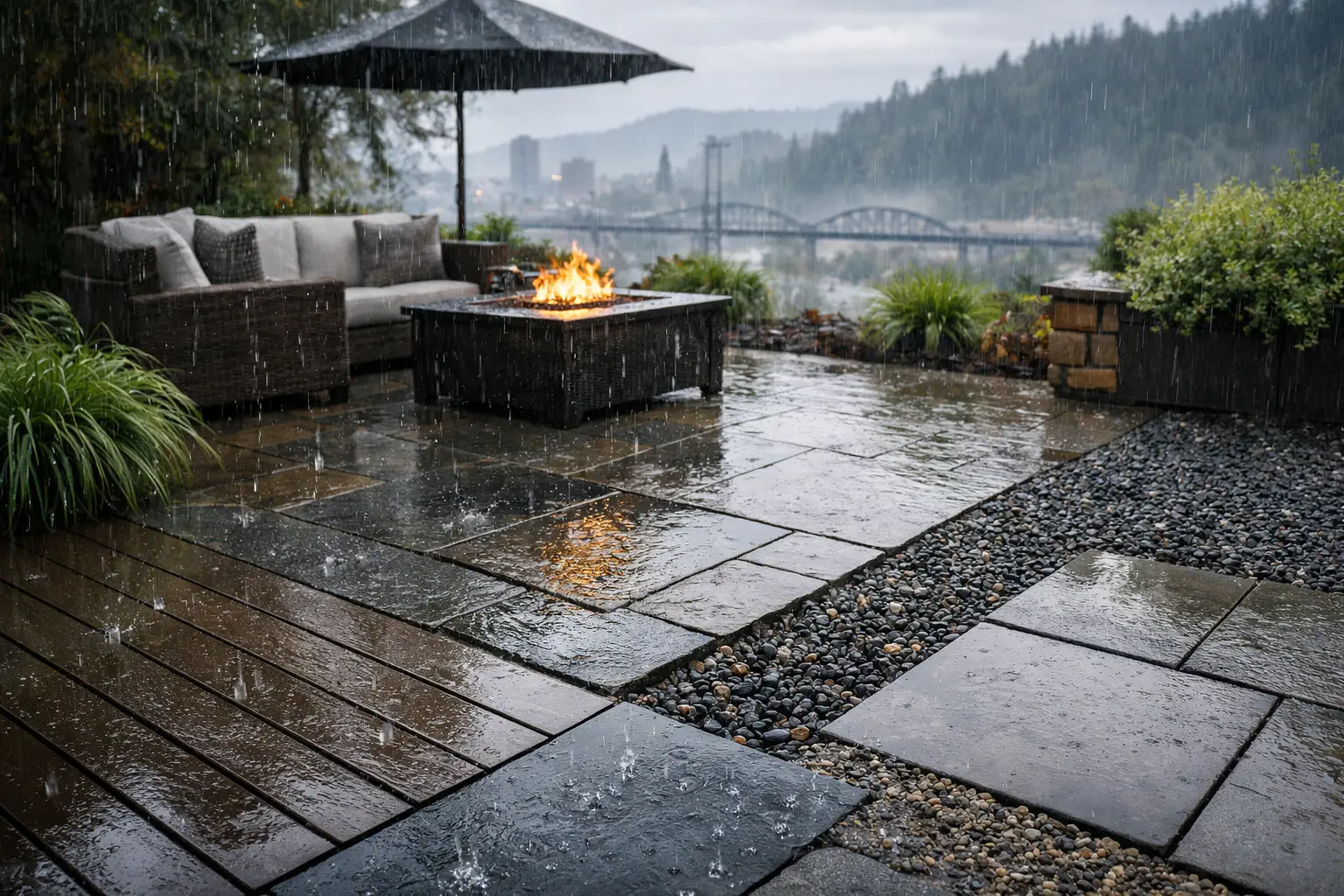
A Portland patio can look excellent in July and still fail during the first long stretch of November rain. The best patio materials for rain are not simply the surfaces that resist water. They are materials installed over a stable base, pitched correctly, and connected to a drainage plan that moves water away from the house.
For homeowners in Tigard, Beaverton, Lake Oswego, Hillsboro, and across the Portland metro area, that distinction matters. Our wet season exposes low spots, loose joints, standing water, moss growth, and drainage shortcuts that may not be visible when a patio is dry. A well-built patio should feel like an extension of the home while protecting the yard, foundation, and surrounding landscape.
What Makes a Patio Work in a Wet Climate
Rain performance starts below the finished surface. Even a high-quality paver, slab, or stone patio can settle or retain water if the excavation, compacted base, edge restraint, and slope are not handled correctly. Material selection is important, but it is only one part of the system.
A patio should generally slope away from the home at about 1/8 to 1/4 inch per foot. That is enough fall to direct surface water without making the space feel noticeably sloped underfoot. Where a yard naturally drains toward the house or a retaining wall, the project may also require a catch basin, channel drain, French drain, or regrading to control runoff.
The right choice also depends on how you use the space. A covered dining patio has different needs than an open area beside a lawn, a poolside surface, or a walkway that receives daily foot traffic. The best result balances drainage, traction, appearance, maintenance, and budget before construction begins.
Best Patio Materials for Rain: Pavers
Interlocking concrete pavers are often one of the strongest choices for rainy Portland-area yards. Individual pavers create a durable, attractive surface while allowing for practical repairs if a section ever settles, stains, or needs access for utility work. Instead of replacing an entire slab, a contractor can remove and reinstall the affected area when the base is properly built.
Pavers are especially useful on properties with challenging grades or soils that experience seasonal movement. Their jointed design is more forgiving than a large monolithic concrete slab, and the wide range of shapes, colors, and laying patterns makes them suitable for contemporary, traditional, and natural-looking landscapes.
Standard pavers are not automatically permeable. Water will still run across the surface and toward the patio edge, which is why proper slope remains essential. For many homes, a standard paver patio combined with well-planned perimeter drainage is the right balance of performance and cost.
Pavers do require occasional maintenance. Joint sand can wash down over time, especially around roof runoff or heavy-use areas, and moss can develop in shaded locations. Polymeric joint sand, routine cleaning, and keeping gutters directed away from the patio help preserve the finished appearance.
Permeable Pavers for Runoff Control
Permeable pavers are designed with wider, stone-filled joints that let water pass through the surface into an open-graded base below. That base temporarily stores water and allows it to infiltrate into suitable soil or drain through a connected system. For yards with recurring puddles or a need to reduce surface runoff, this can be an effective solution.
They are not the answer for every property. Soil permeability, groundwater conditions, roof runoff volume, surrounding grades, and local project requirements all need to be evaluated. A permeable patio installed over poorly draining native soil without an overflow plan can still hold water beneath the surface. When designed as part of a complete drainage strategy, however, it can provide a clean-looking patio with meaningful water-management benefits.
Concrete Patios: Durable With the Right Drainage Details
Concrete remains a dependable patio material for homeowners who want a clean, continuous surface and a lower upfront cost than many premium paver or stone installations. It is easy to furnish, easy to sweep, and can be finished in a range of textures and colors. Broom-finished concrete offers reliable traction in wet weather, while stamped concrete can add a more decorative appearance.
The trade-off is that concrete cracks. Control joints help manage where cracking occurs, but they do not guarantee a crack-free slab. In the Portland area, soil movement, tree roots, inadequate base preparation, and poor water control can all make cracking or settlement more noticeable over time.
For rain, the finish matters as much as the slab itself. A smooth or heavily sealed concrete surface can become slippery when wet, particularly beneath moss or fallen leaves. A slip-resistant texture and a properly pitched slab are better choices for exposed patios, steps, and paths. Concrete also needs carefully planned joints and transitions so water does not collect along the home, at door thresholds, or against adjacent landscaping.
Concrete is a good fit when the site has straightforward grading, the homeowner prefers a streamlined look, and the drainage path is clear. It is less forgiving where significant settlement is likely or where future access to underground utilities is a concern.
Natural Stone: High-End Character With Material-Specific Care
Natural stone gives a patio a lasting, high-end appearance that works especially well with masonry walls, garden beds, and established Northwest landscapes. Flagstone, bluestone, and other dense exterior-rated stones can handle wet conditions well when installed on a stable base with appropriate joints and drainage.
Not all stone performs the same way. Some varieties are more porous, more prone to flaking, or more difficult to keep clean in shaded, damp areas. Polished or very smooth stone can also be slick when wet. The best selection is typically a durable, exterior-rated stone with a naturally textured surface and a color that does not show every bit of debris or seasonal staining.
Dry-laid stone over a compacted aggregate base can allow water to move through the joints, while mortared stone creates a more formal appearance but requires careful waterproofing, drainage, and masonry detailing. Mortared installations can be beautiful, but they should not be treated as a shortcut around site drainage. Water that gets behind or beneath the stone needs a controlled path out.
Natural stone generally costs more because of material weight, cutting, layout, and installation labor. It is often worth the investment for homeowners who want a one-of-a-kind surface and are prepared to maintain it with periodic cleaning and attention to moss in shaded areas.
Porcelain Pavers: Low Absorption, Modern Appearance
Outdoor-rated porcelain pavers are increasingly popular for clean-lined patios and covered outdoor living areas. Because porcelain absorbs very little water, it resists staining and freeze-thaw damage better than many porous materials. It also offers consistent color and a broad selection of stone- and wood-look finishes.
The key is choosing a product rated for exterior use with a textured, slip-resistant finish. Porcelain can be installed over a prepared base, on pedestal systems in certain applications, or with other approved exterior methods. Each approach has different drainage requirements. A smooth porcelain tile intended for interiors is not an appropriate substitute for a properly rated outdoor paver.
Porcelain is often best for homeowners who prioritize a modern finish and easy surface cleaning. It can cost more than basic concrete, and installation accuracy is critical because cutting, leveling, and edge details require experience.
Avoid Letting the Patio Become the Drainage Plan
A patio should direct water intentionally, not merely push it to the nearest edge. Before choosing a material, look at where roof water lands, how the yard slopes, whether downspouts discharge near the planned patio, and where runoff will go after it leaves the surface.
Problems frequently begin when a new patio is installed over an existing low area without correcting the grade. Water may move away from the patio surface only to pool against a fence, saturate a planting bed, or travel toward the foundation. In some cases, regrading, drainage piping, catch basins, or retaining work should happen before the patio is built.
This is where working with one contractor across hardscape, drainage, excavation, and landscape work can prevent costly gaps between trades. Four Seasons Landscape & Construction evaluates the full site condition so the patio, surrounding grade, and water-management details work together rather than competing with one another.
Choosing the Right Material for Your Yard
For many Portland homeowners, standard or permeable pavers offer the best combination of drainage flexibility, repairability, and long-term appearance. Concrete is a practical choice for simple, open spaces with reliable drainage and a preference for a continuous surface. Natural stone is well suited to premium landscape designs where texture and character are priorities, while exterior porcelain fits modern spaces that call for low water absorption and clean lines.
The material alone does not determine success. A patio built with the right slope, base depth, compaction, edge restraint, and drainage outlets will perform better through Oregon rain than a more expensive surface installed without those fundamentals. Before committing to a finish, have the site evaluated during the planning stage. The water already moving through your yard will tell you what the patio needs to do.