

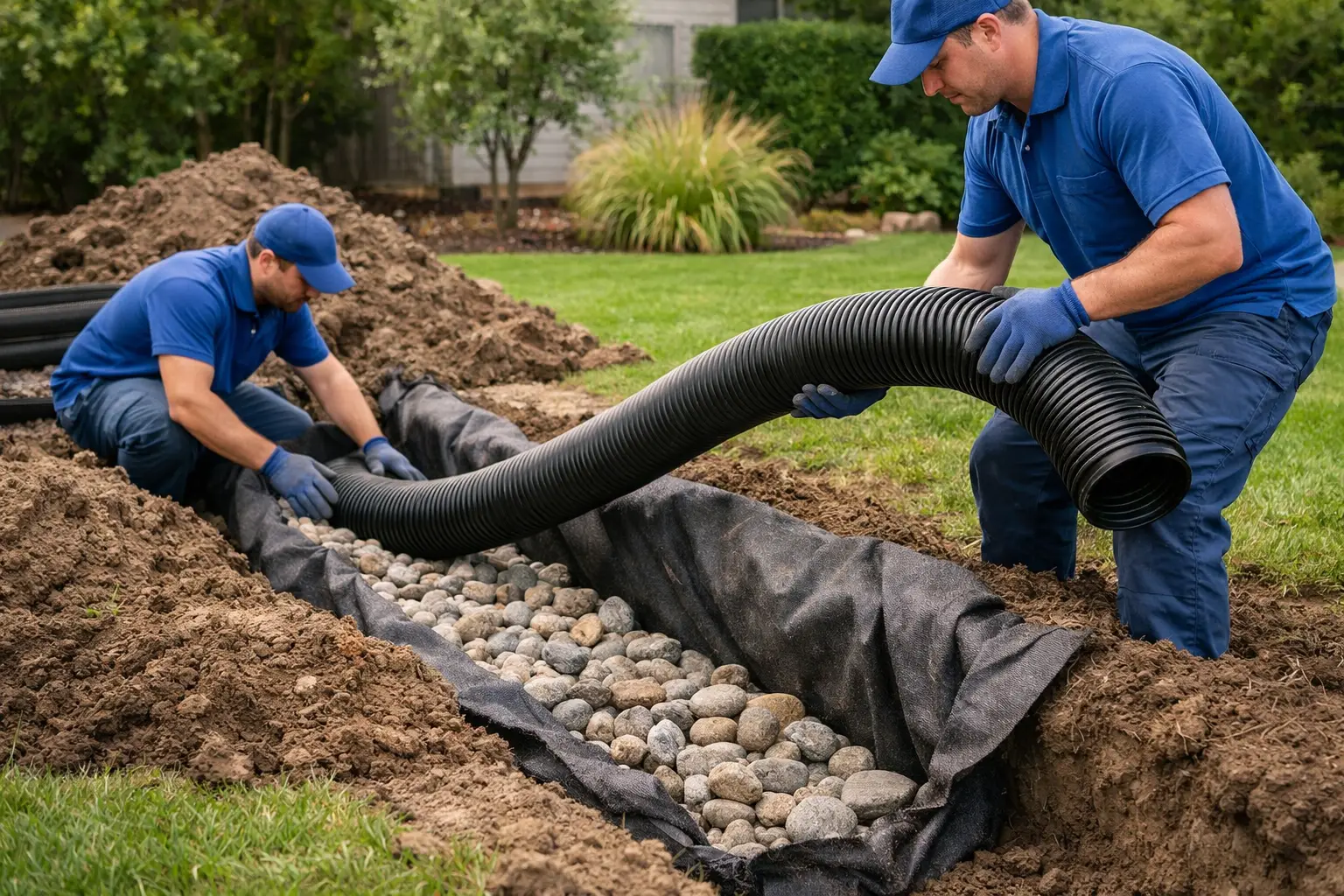
A wet lawn is more than an inconvenience when it returns after every Portland rainstorm. Water that pools near a foundation, runs across a patio, or turns a side yard into mud can limit how you use your property and create larger concerns over time. Professional french drain installation gives that water a planned path away from the areas that need to stay dry.
For Portland-area homeowners, drainage work is rarely a one-size-fits-all project. Soil conditions, slope, existing hardscape, roof runoff, utilities, retaining walls, and the available discharge location all affect the right solution. A properly installed system should solve the source of the problem, protect the surrounding landscape, and fit cleanly into the finished yard.
When a French Drain Is the Right Solution
A French drain is an underground drainage system designed to collect excess groundwater and redirect it to an appropriate outlet. It typically includes a gravel-filled trench, perforated drain pipe, filter fabric, and a discharge point where water can safely leave the system. Unlike a surface swale or catch basin, it works below grade to relieve saturated soil and intercept subsurface water.
It can be an effective solution when water collects in low areas of a lawn, seeps toward a foundation, builds up behind a retaining wall, or leaves planting beds consistently soggy. It is also commonly used along driveways, side yards, and the uphill side of a home where runoff moves toward the structure.
A French drain is not always the answer, however. If the main issue is roof water concentrated at downspouts, solid pipe extensions or a dedicated downspout drain may be more appropriate. If water flows across the surface from a neighboring slope, regrading, a swale, or a combination of drainage methods may provide better control. The best approach starts with identifying where the water begins, where it travels, and where it can legally and practically discharge.
What Proper French Drain Installation Requires
Effective drainage depends on planning as much as excavation. A drain pipe installed without consistent slope, clean gravel, filter fabric, or a reliable outlet may collect water but fail to move it where it needs to go. That can leave homeowners with the same wet conditions after investing in a trench and pipe.
The process begins with a site evaluation. An experienced contractor looks at grading, downspout locations, hardscape elevations, low points, soil saturation, and signs of water intrusion around the home. During this review, it is important to distinguish between standing surface water and groundwater that is moving through the soil. They require different collection methods.
Once the drainage path is determined, the trench is laid out to follow the needed grade. In many residential applications, the trench is excavated deep enough to intercept water below the surface while remaining clear of utility lines, tree roots, and structural footings. The exact depth and width depend on the problem area and site conditions.
A quality installation generally includes several working components:
- Filter fabric separates native soil from the gravel, helping prevent fine sediment from clogging the system.
- Washed drain rock creates open space around the pipe so water can enter and move freely.
- Perforated pipe collects groundwater through its openings and carries it along the designed route.
- A properly planned outlet, such as a suitable lower area, approved storm connection, or other permitted discharge point, gives the water somewhere to go.
The pipe should be installed at a consistent fall toward the outlet. Gravel is placed around and above the pipe, then the filter fabric is wrapped or layered as needed before the trench is backfilled. Depending on the location, the finish may include restored lawn, bark, planting material, decorative rock, a walkway edge, or other landscape improvements that make the repair feel like part of the property rather than an afterthought.
Drainage Design Matters in Portland-Area Yards
The Portland metro area sees long wet seasons, compacted soils, and many properties with uneven grades. In neighborhoods from Tigard and Beaverton to Lake Oswego, Sherwood, Hillsboro, and Portland, drainage conditions can vary significantly from one yard to the next. A solution that works well on a gently sloped lot may not be enough for a home below a hillside or beside a heavily paved area.
Clay-heavy soil is a common challenge. Water moves slowly through dense soil, so it can remain near the surface long after rainfall stops. A French drain can help relieve that saturated zone, but it must be positioned where it can intercept water and built with enough capacity for the affected area. Simply placing pipe in the lowest visible spot does not necessarily correct the broader drainage pattern.
Hardscape elevations also deserve careful attention. A patio, driveway, retaining wall, or concrete walkway can change how rainwater moves across a site. Drainage is often best addressed during a larger outdoor renovation, when grading and finished elevations can be coordinated before new pavers, concrete, sod, or planting beds are installed. This helps avoid tearing out newly completed work later to correct a water issue that could have been planned for from the start.
Protecting Foundations, Retaining Walls, and Usable Space
The most urgent drainage concern is often water near the home. Persistent moisture around a foundation does not automatically mean there is structural damage, but it should not be ignored. Water can contribute to damp crawl spaces, muddy access areas, erosion, and deterioration of nearby landscape materials. Managing the water before it reaches the foundation is usually more practical than repeatedly dealing with its effects indoors.
Retaining walls also need drainage behind them. Soil holds water, and that water adds pressure as it builds up. A wall drainage system may include perforated pipe, drain rock, filter fabric, and carefully placed outlets. The details depend on the wall type, height, site slope, and surrounding conditions. For new wall construction, integrating drainage during installation is far more effective than trying to add it after the wall has shifted or failed.
A well-designed drainage system can also make an underused yard functional again. Areas that stay wet are difficult to mow, unsafe to walk across, and hard to enjoy. Once excess water is redirected, homeowners may be able to add sod, improve planting beds, create a paver walkway, install a patio, or reclaim a side yard that previously stayed muddy for months.
Common Mistakes That Shorten Drain Life
Many drainage problems come from details that are easy to miss during a rushed installation. Using crushed material with too many fines can restrict water movement. Leaving out filter fabric allows soil to migrate into the gravel and pipe. Running perforated pipe without adequate slope can cause water to sit in the line instead of draining out.
The outlet is another frequent issue. Water cannot simply be sent toward a neighboring property or discharged where it will create erosion, ice hazards, or new standing water. Local requirements and site conditions should guide the discharge plan. In some cases, a pop-up emitter, dry well, catch basin, or solid conveyance pipe may be part of the larger system.
Homeowners should also be cautious about connecting every source of water to one undersized drain. Roof runoff can move large volumes of water quickly, while a French drain is intended primarily to collect water in the soil. Separating or properly sizing these systems helps prevent overload during heavy storms.
A Clear Process From Evaluation to Restoration
At Four Seasons Landscape & Construction, drainage projects begin by understanding the property rather than recommending the same fix for every wet yard. The goal is to identify the water source, establish a workable route, and coordinate drainage with any landscape, retaining wall, concrete, or hardscape work planned for the property.
A clear quote should explain the proposed work, including trench locations, drainage materials, discharge approach, site restoration, and any related grading or surface drainage improvements. Homeowners should know what will be disturbed during construction and how the area will be finished when the work is complete.
The right drainage project does more than move water out of sight. It protects the parts of your property that matter, preserves the work you invest in outdoors, and gives you a yard that remains usable when Portland weather is at its wettest. If water is repeatedly finding its way to the same low spot, foundation edge, or retaining wall, a professional site evaluation is the practical first step toward a lasting correction.