

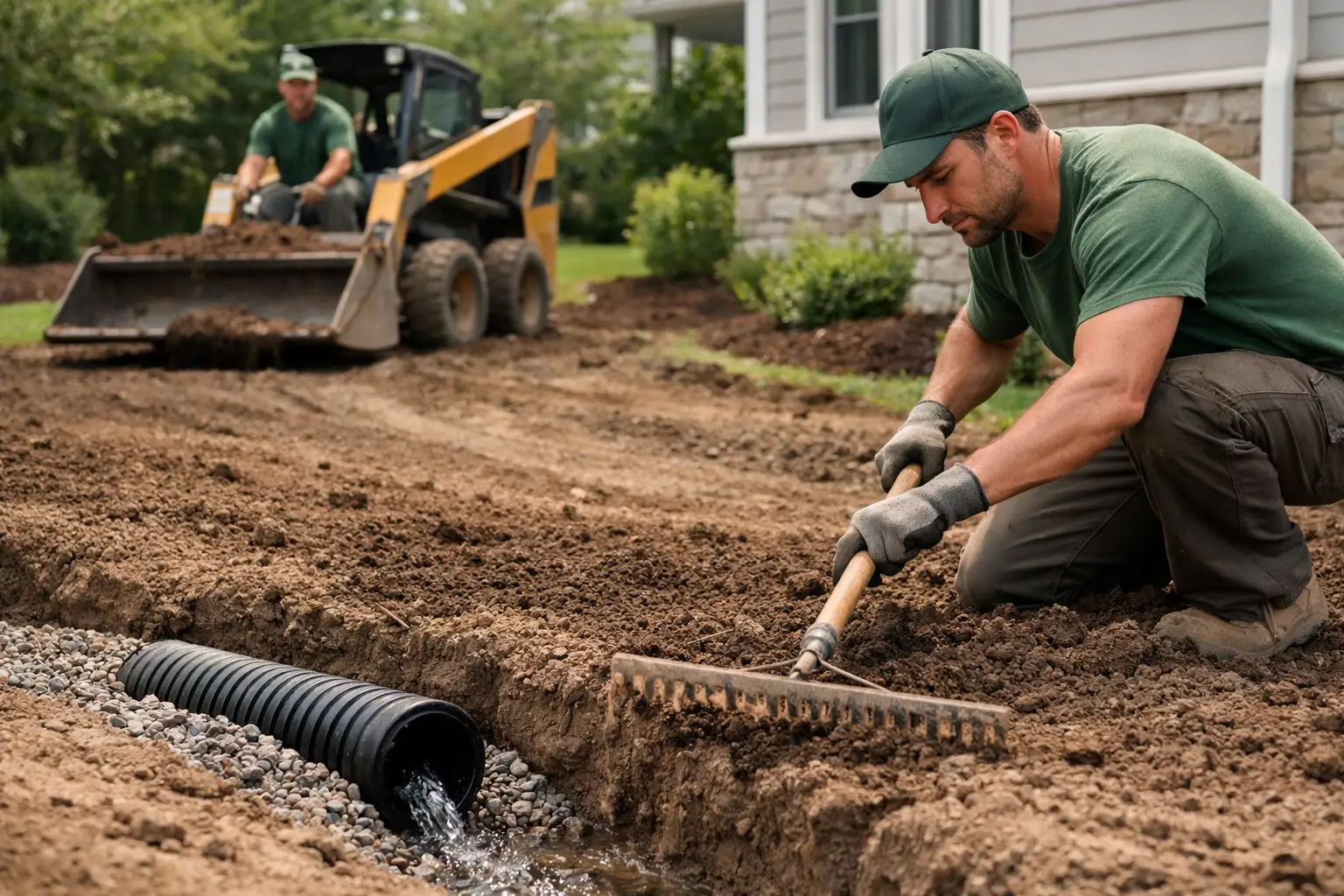
A lawn that stays soggy long after a Portland rainstorm is more than an inconvenience. Water may be collecting near the foundation, washing soil from a slope, undermining a patio edge, or turning usable lawn into mud. Proper yard grading for drainage addresses the slope and flow of the entire property so water has a controlled path away from the places it can cause damage.
For homeowners in Tigard and across the Portland metro area, drainage work is often the first step in a larger outdoor improvement project. A new paver patio, retaining wall, sod installation, fence, or concrete walkway will perform better when the ground beneath it has been shaped correctly from the start.
What Yard Grading for Drainage Actually Does
Yard grading is the process of adjusting soil elevations to direct surface water where it should go. The goal is not to make every part of a yard perfectly flat. In fact, a flat yard can hold water. Effective grading creates intentional slopes, transitions, and collection areas that guide runoff away from the home and toward an appropriate discharge point.
Near a house, the finished grade should generally fall away from the foundation. The exact slope depends on the property, soil conditions, existing structures, and available drainage routes, but the principle is straightforward: water should not sit against the home. When it does, it can increase moisture pressure around the foundation, contribute to crawlspace dampness, and create conditions that may affect siding, landscaping, and hardscape surfaces.
A well-planned drainage grade can also protect the rest of the yard. It helps prevent standing water in lawn areas, reduces erosion on slopes, limits muddy paths near gates and walkways, and keeps runoff from flowing toward a neighbor’s property. On many Portland-area lots, the best solution combines grading with additional drainage components rather than relying on soil reshaping alone.
Signs Your Property May Need Grading Work
Some drainage problems are obvious after a heavy rain. Others develop slowly, especially when soil settles around an older home or landscaping changes the way water moves across the property.
Pay attention to puddles that remain for more than a day, soft or spongy lawn areas, bare channels where water has washed away soil, and mulch that repeatedly migrates out of planting beds. Water stains in a crawlspace, wet foundation walls, moss growth in persistently damp areas, or patio sections that settle can also point to a grading or drainage issue.
Downspout discharge is another common concern. If roof runoff ends at the base of the house or dumps onto a walkway, it can overwhelm a properly sloped yard. The ground may need to be regraded, and the downspout may need an extension, solid drain line, or connection to a suitable drainage system.
Why Portland-Area Yards Need a Site-Specific Plan
The Portland metro area receives significant seasonal rainfall, but rain volume is only part of the equation. Many neighborhoods have compacted soils, mature trees, sloped lots, narrow side yards, or homes built at the low point of a parcel. These conditions can make water management more complex than simply bringing in a few yards of topsoil.
Clay-heavy soil, for example, drains slowly and can remain saturated near the surface. Adding soil on top without correcting the underlying flow may temporarily change the appearance of the yard while leaving the real problem in place. On sloped properties in areas such as Lake Oswego, West Linn, or Happy Valley, runoff can gain speed and carry soil downhill unless it is managed with thoughtful grading, drainage collection, and, where needed, retaining walls.
Property boundaries matter as well. A drainage plan should manage water responsibly on the property rather than directing concentrated runoff toward adjoining homes. Local requirements, existing utility locations, easements, and stormwater infrastructure can all influence the final approach.
The Right Slope Depends on the Whole Yard
A dependable grading plan begins with evaluating elevations, not guessing at them. The contractor should look at the home’s foundation height, existing patios and walkways, downspout locations, gates, driveways, lawn areas, planting beds, and the lowest practical outlet for water.
The finished surface near the house needs enough fall to move water outward, but it cannot be raised so high that it crowds siding, covers weep screeds, or creates clearance issues around doors and vents. That is one reason drainage grading should be coordinated with other sitework instead of treated as an isolated landscaping task.
For a backyard patio project, the patio itself may need a subtle slope away from the house. The surrounding landscape must then accept and carry that water without creating a wet border at the patio edge. For a side yard, the solution may involve a narrow swale, a gravel drainage path, or a buried drain line where there is not enough room to build a broad slope.
Grading Alone Is Not Always Enough
Grading handles surface water well when the site has a clear path for runoff. However, a property with poorly draining soil, a low backyard, or heavy roof runoff may need a more complete drainage system.
A French drain can collect water moving through saturated soil. A catch basin can collect runoff at a low spot or near a hardscape area. Solid drain pipe can carry downspout water away from the foundation, while a swale can provide a shallow, landscaped route for surface runoff. Retaining walls may be needed where a grade change is too steep to manage with soil alone.
Each option has trade-offs. A French drain is useful for subsurface moisture but is not a substitute for correcting a surface slope that directs water toward the home. A catch basin can handle concentrated runoff, but it must be set at the correct elevation and kept clear of debris. A retaining wall creates usable level space, yet it requires proper base preparation, drainage stone, and relief behind the wall to perform over time.
The best systems often use several elements together. Grading establishes the overall direction of water, hardscape surfaces are pitched intentionally, and drains handle water where grading cannot solve the problem by itself.
How Professional Grading Is Completed
A quality project starts with an on-site assessment. The contractor identifies where water enters the yard, where it collects, and where it can be safely directed. This step also reveals conflicts that are easy to miss, such as shallow utilities, buried irrigation lines, failing edging, or a fence that limits equipment access.
Next comes the grading plan. Depending on the project, this may involve excavation, removal of unsuitable soil, import of clean fill, compaction in controlled lifts, and final shaping. On a larger yard renovation, rough grading is completed before patios, walls, irrigation, and planting features are installed. Finish grading occurs later, when topsoil, sod, or seed can be placed over a stable, properly sloped base.
Compaction deserves careful attention. Soil that is not compacted correctly can settle, changing drainage patterns and causing hardscape edges to move. At the same time, overly compacted finish soil can make it difficult for turf and plants to establish. Skilled sitework balances structural stability in build areas with healthy growing conditions in lawn and planting areas.
Common Shortcuts That Create Bigger Problems
Adding a thin layer of topsoil over a wet area is a frequent short-term fix. It may hide low spots for a season, but the water often returns as the new material settles or becomes saturated. Similarly, placing gravel in a puddle without addressing elevation can create a gravel-filled puddle rather than a drainage solution.
Another mistake is installing a patio, walkway, or retaining wall before deciding how water will move around it. These features change the flow of runoff. A new patio can shed water toward a lawn, a wall can block an existing drainage path, and a walkway can act like a small dam if the adjacent grade is wrong.
The most reliable approach is to plan drainage before construction begins. Four Seasons Landscape & Construction can coordinate excavation, drainage, hardscape, concrete, and landscape installation as one connected project, helping homeowners avoid piecemeal work and mismatched elevations.
Protecting the Finished Work
After grading is complete, the yard still needs reasonable maintenance. Keep downspout outlets clear, remove leaves from catch basins, and watch for changes after major storms. Freshly placed soil and new sod can settle slightly during the first year, particularly through wet winter weather.
If a low spot begins to form, addressing it early is usually straightforward. Waiting until water reaches the foundation, settles a patio, or erodes a slope can turn a small adjustment into a more involved repair. A properly graded yard does not just look cleaner after rain – it gives every other outdoor improvement a stronger, longer-lasting foundation.